Gothic Style Arched Windows Vector with Detailed Tracery for Architectural Design
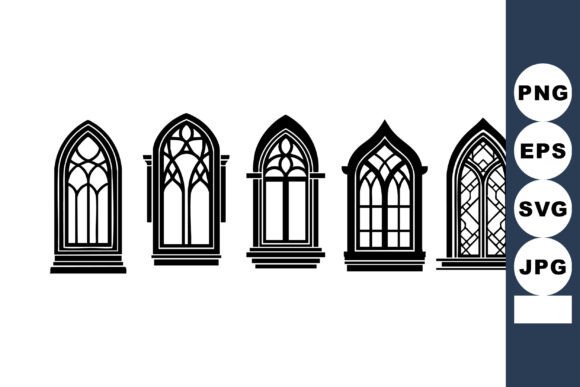
In the realm of digital architectural visualization and graphic design, the choice of assets can significantly influence the final aesthetic. Among the most enduring and visually striking elements are Gothic-style windows. A Gothic Style Arched Windows Vector with intricate tracery patterns offers designers a versatile tool for adding historical depth and elegance to modern projects. These assets are not merely decorative; they serve as functional components in layout design, branding, and architectural illustration. Understanding the specific value of high-quality vector files, particularly those featuring five distinct arched windows with detailed black-and-white linework, helps professionals make informed decisions about their resource libraries.
Understanding the Distinctive Features of Gothic Tracery
Gothic architecture is defined by its verticality, light, and complex stone structures. The window is perhaps the most iconic element of this style, characterized by pointed arches and elaborate stone mullions known as tracery. When selecting a Gothic Style Arched Windows Vector with these characteristics, it is essential to recognize what separates a generic silhouette from a professionally crafted asset. The primary distinction lies in the precision of the lines and the accuracy of the historical references.
The downloadable ZIP package typically includes SVG, EPS, JPG, and PNG files, each serving a different purpose in the design workflow. The vector formats (SVG and EPS) are crucial because they allow for infinite scalability without loss of quality. This is particularly important for the fine details of tracery patterns, which can easily become pixelated or blurred in raster images if enlarged. The clean, elegant black-and-white presentation ensures that these windows can be easily integrated into various color schemes or used as masks and clipping paths in more complex compositions.
The Role of Detailed Tracery in Visual Impact
Tracery is the stonework elements that support the glass in a Gothic window. In a vector format, these patterns must be rendered with mathematical precision. A well-designed set will feature five gothic arched windows, each with unique tracery configurations. This variety is vital for avoiding repetition in large-scale designs, such as wallpaper patterns, facade illustrations, or background textures. The calm, monochromatic style allows the complexity of the geometry to take center stage, providing a sophisticated backdrop that does not overwhelm the primary content of a design project.
Comparing Vector Assets to Raster and Hand-Drawn Alternatives
When evaluating resources for architectural design, professionals often weigh the benefits of pre-made vectors against other options. Understanding these tradeoffs is key to efficient workflow management.
- Vectors vs. Raster Images: Raster images (such as standard JPEGs or PNGs found on stock photo sites) are resolution-dependent. If a designer needs to print a large poster or banner featuring a Gothic window, a raster image may appear jagged or blurry. A Gothic Style Arched Windows Vector with scalable paths ensures crisp edges at any size. However, raster images may offer realistic lighting and texture effects that vectors lack, making them better for photorealistic renderings where the window is part of a photographed scene.
- Vectors vs. Hand-Drawn Illustrations: Commissioning a custom illustration provides unique, bespoke artwork but comes with higher costs and longer turnaround times. Pre-made vector sets offer an immediate, cost-effective solution. While they may lack the singular artistic flair of a hand-drawn piece, high-quality vectors provide consistency and technical accuracy that can be difficult to achieve manually, especially for repetitive patterns.
- Vectors vs. 3D Models: For architectural visualization, 3D models offer depth and perspective. However, they are computationally heavy and require specialized software to manipulate. Vector graphics are lightweight, easy to edit in standard graphic design tools, and ideal for two-dimensional applications such as logos, brochures, and web graphics where depth is not required.
Evaluating File Formats: SVG, EPS, JPG, and PNG
The inclusion of multiple file formats in a single download enhances the usability of the asset. Each format has specific strengths that cater to different stages of the design process.
- SVG (Scalable Vector Graphics): This format is ideal for web design. It is code-based, meaning it loads quickly and can be manipulated with CSS for interactive effects. For digital architects presenting portfolios online, SVGs ensure that window details remain sharp on high-resolution screens.
- EPS (Encapsulated PostScript): EPS is the industry standard for print production. It is compatible with most professional design software, including Adobe Illustrator and CorelDRAW. Designers working on printed materials, such as architectural proposals or historical brochures, should rely on EPS files for the highest fidelity.
- JPG (Joint Photographic Experts Group): While not scalable, JPGs are useful for quick previews or for use in presentations where vector editing is not required. They are universally compatible and easy to share.
- PNG (Portable Network Graphics): PNGs support transparency, making them excellent for layering. A designer can place a PNG of a Gothic window over a textured background without worrying about a white box surrounding the image. This is particularly useful for composite images and digital collages.
Practical Applications and Best-Fit Scenarios
Determining when to use a Gothic Style Arched Windows Vector with detailed patterns depends on the project's goals. These assets are particularly well-suited for specific industries and creative endeavors.
Architectural Presentations: Architects often need to illustrate historical contexts or propose renovations for heritage buildings. Vector windows can be overlaid onto floor plans or elevation drawings to indicate fenestration styles without cluttering the technical details. The clean lines complement the precision of CAD drawings.
Branding and Identity: Businesses in sectors such as law, education, or luxury hospitality often seek to convey tradition, stability, and elegance. Gothic elements are powerful symbols of these values. A logo or letterhead incorporating a subtle Gothic arch can evoke a sense of established authority. The black-and-white palette ensures that the branding remains versatile and printable in single-color formats.
Interior Design and Decor: Graphic designers creating wallpaper patterns, textile prints, or decorative panels can use these vectors to create seamless repeats. The intricate tracery provides visual interest without being overly busy, contributing to a calm and sophisticated atmosphere. The ability to scale the pattern allows for customization based on the size of the room or product.
Limitations and Considerations for Designers
While versatile, vector assets are not a universal solution. Designers must be aware of their limitations. For instance, vectors lack the photographic realism required for high-end architectural renderings intended to mimic real-life lighting conditions. In such cases, 3D modeling or photography is more appropriate. Additionally, the complexity of Gothic tracery can sometimes result in large file sizes if every small detail is preserved as a separate path. Designers may need to simplify the vectors for web use to maintain fast loading times.
Another consideration is stylistic consistency. Gothic architecture spans several centuries, from Early English to Perpendicular styles. A single set of five windows may not cover all sub-styles. Designers working on historically specific projects should verify that the tracery patterns align with the correct period. Using an anachronistic window style can undermine the credibility of a historical reconstruction.
Making an Informed Decision
Choosing the right design resources involves balancing quality, convenience, and suitability. A Gothic Style Arched Windows Vector with comprehensive file support offers a strong foundation for many creative tasks. It provides the flexibility of vector editing, the convenience of multiple formats, and the aesthetic appeal of classical architecture. However, it is not a substitute for custom illustration when uniqueness is paramount, nor for 3D modeling when realism is required.
For professionals seeking to enhance their design toolkit, investing in high-quality vector assets is a practical step. These resources save time, ensure technical accuracy, and provide a timeless aesthetic that resonates with audiences. By understanding the specific features and appropriate use cases of Gothic window vectors, designers can integrate them effectively into their workflows, creating work that is both visually compelling and professionally executed. The key is to view these vectors not as standalone solutions, but as flexible components within a broader design strategy.