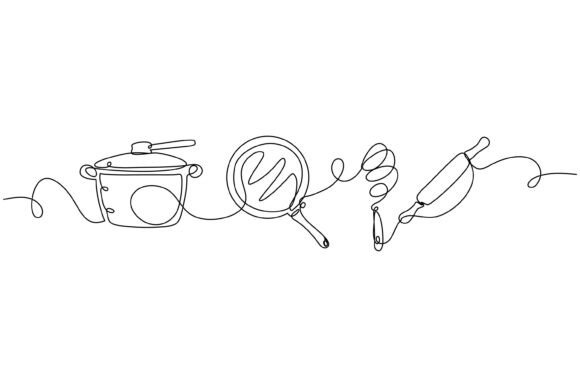
Continuous Line Design of Kitchen
The elegance of minimalism finds a perfect partner in the fluidity of continuous line art. When applied to interior concepts, specifically the continuous line design of kitchen spaces, this artistic technique transforms complex architectural layouts into singular, unbroken visual narratives. A single decorative element drawn on white space does more than decorate; it simplifies, clarifies, and elevates the subject matter. For designers, homeowners, and digital creators alike, this style offers a unique blend of modern aesthetic appeal and technical simplicity.
Understanding this design approach requires looking beyond the surface. It is not merely about drawing a kitchen without lifting the pen. It is about capturing the essence of functionality and form through restraint. Whether you are evaluating a vector file for a branding project or seeking inspiration for a home renovation mood board, the continuous line aesthetic provides a versatile foundation. The availability of these designs in multiple formats—specifically EPS, SVG, and JPG—ensures that the utility of the artwork extends across both digital and print mediums, catering to a wide spectrum of users.
The Essence of Unbroken Form
At its core, the continuous line design of kitchen relies on the principle that less is more. By removing color, shading, and fragmented details, the viewer’s eye is forced to follow the path of the line. This creates a sense of movement and connectivity. In a kitchen context, this means the relationship between the stove, the sink, the refrigerator, and the countertops is highlighted as a cohesive unit rather than separate appliances.
This stylistic choice resonates deeply with contemporary interior trends that favor open spaces and clean lines. The white background serves as negative space, allowing the black or colored line to breathe. For a homeowner, this might represent the clarity they seek in their living environment. For a graphic designer, it represents a challenge in composition: how to convey recognizable objects using the fewest possible strokes.
Perspectives from Different Creators
The value of a continuous line illustration varies significantly depending on who is holding the mouse or the pen. What matters to a hobbyist may differ vastly from the priorities of a marketing professional. Understanding these distinctions helps in selecting the right file format and application for your specific needs.
For Graphic Designers and Branding Experts
Professionals in the creative industry prioritize flexibility and scalability. When a designer downloads a continuous line design of kitchen appliances, they are likely looking for assets that can be manipulated without loss of quality. This is where the file format becomes critical.
- SVG (Scalable Vector Graphics): Ideal for web design and user interfaces. It allows for code-based manipulation, meaning colors can be changed via CSS, and the image remains crisp on any screen size.
- EPS (Encapsulated PostScript): The standard for print. If a designer is creating a high-end brochure for a real estate development or a menu for a restaurant, EPS ensures that the lines remain sharp even when printed on large-format materials.
For these users, the "single line decorative element drawn on white" is not just art; it is a modular component. They may isolate specific parts of the kitchen line art to create icons for an app or combine multiple elements to build a larger scene. Their primary concern is technical reliability and ease of editing.
For Interior Designers and Architects
Interior professionals often use continuous line art for conceptual presentations. Before a kitchen is built, clients need to visualize the flow. A continuous line sketch can abstract away the clutter of material samples and color palettes, focusing instead on the layout and ergonomics.
An architect might use a continuous line design of kitchen layouts to demonstrate the "work triangle" concept—the efficient movement between cooking, cleaning, and storage zones. The simplicity of the line drawing makes it an excellent tool for communication during early client meetings. It suggests sophistication and modernity, aligning well with minimalist interior design proposals. Here, the JPG format might suffice for quick email attachments, but the vector files are kept on hand for high-resolution renderings.
For Content Creators and Bloggers
Digital marketers, food bloggers, and lifestyle influencers operate in a fast-paced environment where visual consistency is key. A continuous line illustration of kitchenware or a full kitchen scene adds a touch of artisanal charm to blog posts, social media graphics, and email newsletters.
For this audience, ease of use is paramount. They may not have advanced skills in Adobe Illustrator. Therefore, having access to a JPG version allows for immediate drag-and-drop usage in platforms like Canva or WordPress. However, those with slightly more technical skill might appreciate the SVG format for embedding lightweight, fast-loading images on their websites, which improves SEO performance. The aesthetic appeals to their desire for content that feels curated and authentic rather than stock-photo generic.
For Hobbyists and DIY Enthusiasts
The rise of home crafting has brought continuous line art into the physical world. Hobbyists who own cutting machines, such as Cricut or Silhouette devices, find immense value in SVG files. A single line design of kitchen appliances can be sent directly to a cutter to create vinyl decals for mason jars, kitchen walls, or tote bags.
The simplicity of the design reduces cutting time and minimizes errors. For a beginner, the forgiving nature of a thick, continuous line is easier to work with than intricate, multi-layered illustrations. Additionally, these designs are popular for hand-lettering practice and bullet journaling, where users trace the lines to improve their own drawing skills. The educational value here is significant, as studying how the line connects different objects teaches spatial awareness and composition.
Evaluating Quality and Usability
When selecting a continuous line design of kitchen asset, several factors determine its suitability for your project. Not all line art is created equal. Some lines may be jagged or uneven, while others flow with mathematical precision. The best designs strike a balance between organic feel and structural accuracy.
Flexibility is another major consideration. Does the design allow for easy separation of elements? For instance, can the toaster be removed from the counter line without breaking the continuity of the rest of the drawing? High-quality vector files often come with layered components, even if the visual result is a single line. This allows professionals to customize the scene.
Cost and Licensing also play a role. Free resources may offer JPGs but lack the editable vector files. Paid assets typically provide the full suite of EPS, SVG, and JPG formats, offering better long-term usefulness. For business owners, investing in proper licensing ensures legal safety when using the imagery in commercial products or advertising.
Practical Applications Across Industries
The versatility of this design style allows it to permeate various sectors. Consider a cookbook publisher. Using continuous line illustrations for chapter headers or section dividers creates a cohesive visual language that is elegant and unobtrusive. It does not compete with the photography of the food but complements it.
In the tech sector, a startup developing a smart home app might use continuous line design of kitchen appliances as icons within their interface. The clean lines translate well to small screens, ensuring usability and aesthetic appeal. The SVG format ensures that these icons look sharp on high-density displays.
For educators teaching art or design, these files serve as excellent case studies. Students can analyze how the artist solved the problem of connecting disparate objects. They can practice tracing, modifying, and recreating the lines, learning about weight, balance, and negative space.
Making the Right Choice for Your Needs
To determine if a continuous line design of kitchen is right for your project, ask yourself what the primary goal is. If you need speed and simplicity for a social media post, a JPG may be sufficient. If you are building a brand identity or a physical product, the vector formats (EPS and SVG) are non-negotiable.
Consider your skill level. If you are a beginner, start with the JPGs to understand how the images fit into layouts. As you grow more comfortable, explore the SVG files to experiment with color and scale. For professionals, the focus should be on the integrity of the vector paths and the ease of integration into existing workflows.
Ultimately, the appeal of the single line decorative element drawn on white lies in its adaptability. It is a blank canvas for interpretation. Whether used to sell a luxury apartment, decorate a coffee mug, or teach a design principle, the continuous line kitchen design offers a timeless, sophisticated solution that bridges the gap between art and function.